
Buyer's Desk
GE vs. Siemens vs. Philips Refurbished CT Scanners: Which Brand Is Right for You?
March 27, 2026 · 6 min · Medical Imaging Specialists
Practical considerations, risk points, and what to ask before you buy, service, move, or maintain imaging equipment.
Meta Title: GE vs. Siemens vs. Philips Refurbished CT Scanners | Which Is Best for Your Facility?
Meta Description: Comparing GE, Siemens, and Philips refurbished CT scanners? This guide breaks down image quality, parts availability, service costs, and which platform fits your facility’s needs and budget.
When you’re shopping for a refurbished CT scanner, the brand question comes up almost immediately. GE, Siemens, and Philips are the three heavyweights in the CT market — and each has a loyal following, distinct platform characteristics, and real-world trade-offs that matter when you’re spending $150,000 to $600,000+ on a system.
This guide breaks down the key differences between GE, Siemens, and Philips refurbished CT scanners across five dimensions every buyer should evaluate: image quality and technology, ease of use, parts and service availability, software and upgrade paths, and total cost of ownership.
Why Brand Matters More in the Refurbished Market
New CT purchases often come down to dealer relationships, service contract negotiations, and corporate pricing. In the refurbished market, the calculus shifts. Brand choice affects:
- Parts availability — which platforms have abundant aftermarket support
- Engineer familiarity — which systems your local service provider actually knows
- Software licensing — which platforms allow application transfers vs. require costly re-licensing
- Resale value — which systems hold value when you trade up
Let’s look at each platform honestly.
GE CT Scanners: The Workhouse Standard
GE is consistently the most popular CT platform in the refurbished market, and for good reason. Systems like the GE LightSpeed series and the GE Discovery platform have been deployed in enormous volumes worldwide, which creates deep parts availability and a large pool of trained engineers.
Strengths:
- Widest parts availability of any CT platform — aftermarket and OEM parts are plentiful
- High scanner volume means more certified engineers across the US, Caribbean, and LATAM
- Reliable gantry and tube design with predictable failure modes
- Strong used system volume means competitive pricing at 16, 32, and 64-slice configurations
Weaknesses:
- Older LightSpeed platforms (16-slice and below) are approaching end-of-software-support
- GE’s proprietary software licensing can be restrictive for application transfers on older systems
- Interface is considered less intuitive by some technologists compared to Siemens
Best fit: High-volume outpatient imaging centers, hospitals looking to expand capacity, and facilities in LATAM or the Caribbean where GE service infrastructure is most accessible.
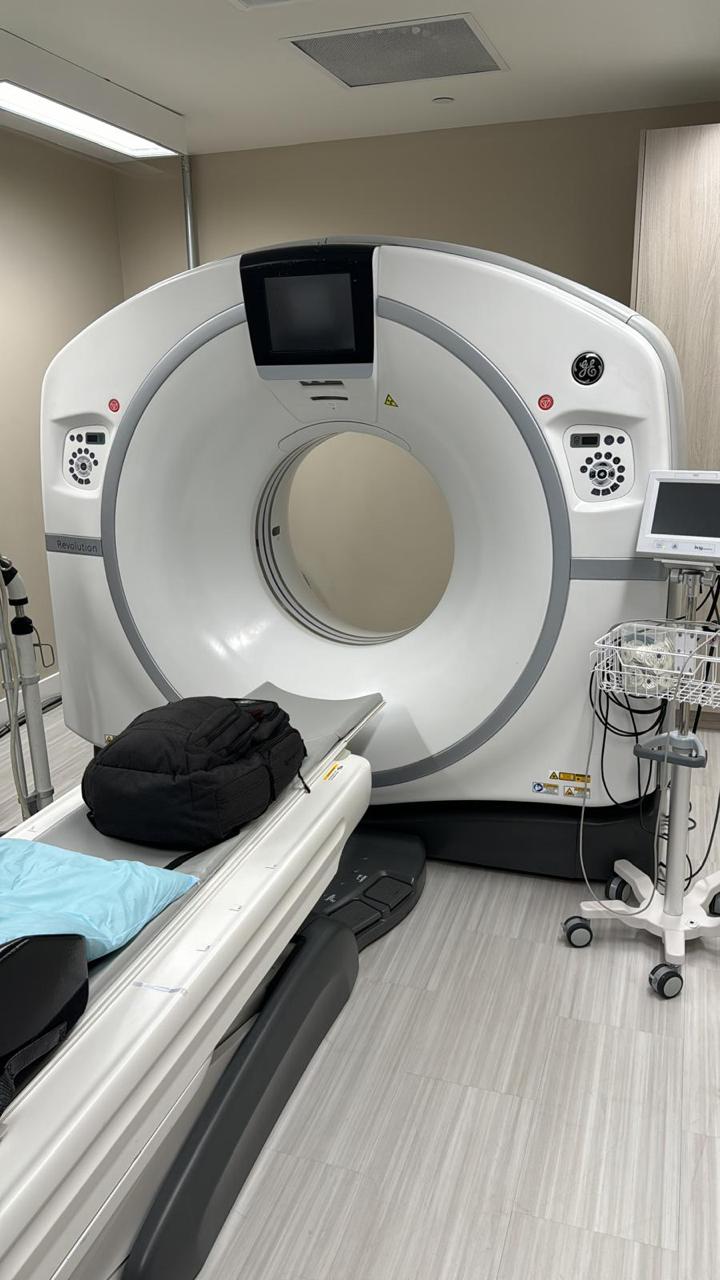
Popular refurbished models: GE LightSpeed VCT 64-slice, GE Discovery CT750 HD, GE Revolution EVO
Siemens CT Scanners: Engineering-First Performance
Siemens CT scanners (now Siemens Healthineers) are known for pushing the envelope on image quality and dose reduction. The SOMATOM platform has long been a favorite in academic medical centers and high-acuity hospitals that prioritize imaging performance above all else.
Strengths:
- Best-in-class image quality on many platforms, particularly DECT (dual-energy) capable systems
- CARE Dose4D and iterative reconstruction algorithms set a high bar for dose efficiency
- Siemens’ syngo software environment is consistent across generations — technologists adapt quickly
- Strong resale value, especially SOMATOM Definition and Force series
Weaknesses:
- Parts availability is solid for newer platforms but tighter for older SOMATOM Sensation-era systems
- Siemens service infrastructure is thinner in smaller markets compared to GE
- Higher average acquisition cost in the refurbished market
- Some components (e.g., detector modules) can be expensive to source outside OEM channels
Best fit: Imaging centers and hospitals where image quality and advanced clinical protocols (cardiac CT, dual-energy) are top priorities, and where a strong local Siemens service presence exists.
Popular refurbished models: Siemens SOMATOM Definition AS+, Siemens SOMATOM Definition Flash, Siemens SOMATOM Edge
Philips CT Scanners: Dose Efficiency and Ergonomics
Philips has carved out a strong following among facilities that prioritize dose management and workflow ergonomics. The Brilliance and iCT platforms are solid performers, and Philips’ detector technology has earned respect for low-dose pediatric and cardiac protocols.
Strengths:
- IMR (iterative model reconstruction) delivers excellent noise reduction at low doses
- IntelliSpace Portal software is intuitive and well-regarded by technologists
- Philips iDose⁴ is one of the strongest dose-reduction platforms in its generation
- Competitive acquisition pricing in the refurbished market, particularly for 64-slice systems
Weaknesses:
- Parts availability is narrower than GE and sometimes Siemens — important in markets with limited OEM access
- Fewer independent engineers trained on Philips CT compared to GE
- Older Brilliance platform (pre-iCT) is showing age; software support is limited
- Resale value trails GE and Siemens on most configurations
Best fit: Facilities where dose-reduction protocols are clinically critical, or buyers who want strong value on a 64-slice system and have access to Philips-trained service support.
Popular refurbished models: Philips Brilliance iCT 256, Philips Ingenuity CT 128, Philips Brilliance 64
Parts Availability: The Factor Buyers Underestimate
Across all three platforms, parts availability is the variable that has the biggest real-world impact on uptime and total cost of ownership — especially outside major US metro areas.
As a rule of thumb:
- GE: Best parts availability by volume; large independent parts market
- Siemens: Good for current-generation platforms; tighter on legacy systems
- Philips: More dependent on OEM or specialized parts suppliers; plan accordingly
For facilities in the Caribbean or LATAM, this matters even more. GE’s installed base in those regions is typically larger, meaning local engineers and parts pipelines are better developed. Siemens and Philips systems in those markets often require longer lead times for parts, which translates directly to longer downtime windows.
Questions to Ask Before You Choose a Platform
Regardless of which brand you’re leaning toward, ask your vendor these questions:
- What is the parts support situation for this specific platform and model year?
- Who will be servicing this system — OEM, third-party, or in-house — and what’s their certification on this platform?
- Is the software license transferable, and what applications are included?
- What is the typical lead time for a detector or tube replacement on this system?
- What’s the estimated tube life remaining, and does the system come with a tube warranty?
These questions separate buyers who are prepared from buyers who learn the hard way.
The Bottom Line
There’s no universally “best” brand in refurbished CT — the right platform depends on your clinical needs, service infrastructure, budget, and location.
- Choose GE if parts availability, service ecosystem, and value are your priorities.
- Choose Siemens if advanced imaging performance and dose efficiency justify the premium.
- Choose Philips if low-dose protocols and workflow ergonomics are your main drivers and you have reliable Philips service access.
Talk to Medical Imaging Specialists Before You Decide
At Medical Imaging Specialists, we’ve been working with GE, Siemens, and Philips CT systems since 2004 — buying, refurbishing, and supporting all three platforms across the US, Caribbean, and LATAM. We carry in-house parts inventory and have our own engineers, so we can give you an honest read on what each system actually costs to run over time — not just what it costs to buy.
If you’re evaluating refurbished CT scanners and want a straight answer on which platform fits your situation, reach out to our team. We’re based in Bradenton, Florida, and we work with facilities of every size. Let’s find the right system for you.
[Contact Medical Imaging Specialists →]
Related Reading
Talk Through Your Next Imaging Project
If you are evaluating refurbished imaging equipment, planning a service strategy, or trying to keep an aging scanner productive, Medical Imaging Specialists can help. Contact MIS through the website and tell us what system you are working with.
Need help with this exact problem?
Send the modality, site location, timeline, and any system details. MIS will route the request by intent.
Related resources
Buyer's Desk
What Is a Fair Price for Used X-Ray Equipment?
A fair used X-ray equipment price depends on scope, detector condition, site readiness, installation, service, parts, and support.
Buyer's Desk
How Much Does Used Medical Imaging Equipment Cost?
Used medical imaging equipment cost depends on modality, model, condition, site work, installation, service, parts, and support scope.
Buyer's Desk
Best Used MRI for an Outpatient Imaging Center
Choose the right used MRI for an outpatient center by matching field strength, bore size, coils, site needs, service, and volume.