
Buyer's Desk
How Much Does a Mobile MRI Lease Cost in 2026?
May 2, 2026 · 6 min · Medical Imaging Specialists
Practical considerations, risk points, and what to ask before you buy, service, move, or maintain imaging equipment.
Considering a lease instead?
Equipment, service, PMs, parts, and applications support can be bundled into one monthly payment.
If this article is about financing, ROI, service contracts, or total cost of ownership, the leasing model may simplify the decision.
A mobile MRI lease cost is not one number. It is a stack of decisions: which magnet, which trailer, how long you need it, who services it, whether you need technologists, and how clean your site is before the unit arrives.
That is why two facilities can ask for “a mobile MRI lease” and get very different quotes. One is covering a three-month construction project with its own MRI staff. The other is launching a new outpatient route, needs a wide-bore 1.5T, wants service included, and has never hosted a trailer before.
Same modality. Completely different operating plan.
The smart way to evaluate mobile MRI leasing is to price the whole workflow, not just the trailer.
What drives mobile MRI lease cost?
The biggest cost driver is the MRI system itself. A mobile trailer carrying a legacy 60 cm 1.5T magnet is a different asset than a newer wide-bore 1.5T or 3T platform. Model, software level, coil package, magnet condition, and applications support all affect the quote.
Common mobile MRI platforms include GE Signa, GE Optima, GE Discovery, Siemens Avanto/Espree/Aera, and Philips Achieva/Ingenia families. In the refurbished market, availability changes constantly because mobile-certified systems are a narrower pool than fixed-site systems. Not every MRI belongs in a trailer, and not every trailer is configured for every magnet.
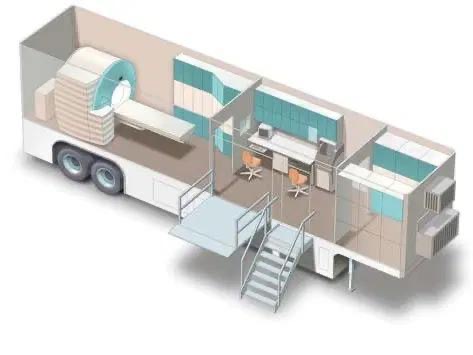
The trailer matters too. A proper mobile MRI trailer is not just a box with a magnet inside. It has RF shielding, HVAC, electrical distribution, patient handling space, control room layout, safety zoning, ramp or lift access, and environmental systems designed around MRI operation. Trailer condition can affect uptime just as much as magnet condition.
Lease term is the next major variable. A short emergency rental for a down scanner usually prices differently than a planned six-month construction bridge or multi-year mobile program. The longer the term, the more room there usually is to structure the economics around predictable utilization instead of urgency.
Dry lease vs turnkey mobile MRI service
Before comparing quotes, make sure every vendor is quoting the same service model.
A dry lease usually means you are leasing the mobile MRI asset: trailer, scanner, and associated equipment. Your facility supplies the technologists, scheduling, radiology workflow, contrast protocols, patient intake, billing, and day-to-day operations. This can work well for hospitals and imaging centers that already have MRI staff and simply need capacity.
A turnkey mobile MRI program typically includes more operational support. Depending on the provider, that may include technologists, applications help, route planning, maintenance coordination, and a more complete operating package. It costs more because you are not just leasing equipment — you are buying capacity.
Do not compare a dry lease quote against a turnkey quote and assume one vendor is cheaper. They may be selling two different things.
For a facility that already operates fixed-site MRI, dry leasing can be efficient. For a clinic adding MRI for the first time, turnkey support may prevent expensive mistakes. If you are not sure which structure fits, start with the operational question: who is actually responsible for scanning patients on day one?
Site readiness can make or break the mobile MRI budget
Mobile MRI feels temporary, but the site work is real. You still need a safe, compliant place to park and operate a superconducting magnet.
At minimum, the project team should evaluate:
- Trailer pad or parking surface, including levelness and load support
- Truck access, turning radius, and delivery clearance
- Shore power requirements and distance to electrical service
- HVAC support and environmental conditions
- Patient access, ADA path, ramp or lift workflow
- Emergency access and staff movement around the trailer
- Magnetic safety zones and ferromagnetic risk control
- Network, PACS, RIS, DICOM, phone, and IT connectivity
- Security, lighting, weather exposure, and drainage
This is where buyers get surprised. The lease quote may look reasonable, then the facility discovers it needs electrical work, trenching, concrete, networking, weather protection, or workflow changes before the trailer can scan a patient.
If you are comparing mobile MRI against a fixed-site build, read our guide to MRI site planning, RF shielding, and cryogen requirements. A mobile unit avoids some construction, but it does not eliminate planning.
Which MRI system should you lease?
Most mobile MRI programs are built around 1.5T because it is the workhorse field strength for routine outpatient imaging. It handles neuro, spine, MSK, abdomen, pelvis, and many vascular studies with broad radiologist acceptance and generally lower operating complexity than 3T.
A 3T mobile MRI can make sense for advanced neuro, MSK, oncology, research, or a market where premium imaging is part of the referral strategy. But it also raises the bar for siting, safety planning, service expertise, coil support, and total cost.
Wide-bore 1.5T systems are often the sweet spot for outpatient mobile programs. Platforms like the GE Optima MR450w or GE Discovery MR450w combine a 70 cm bore with familiar 1.5T economics. That patient-comfort advantage matters when the unit is supporting community imaging, orthopedic referrals, or high-throughput outpatient schedules.
If you are still deciding between field strengths, see our 1.5T vs 3T refurbished MRI guide. The same clinical tradeoffs apply in a mobile trailer — the trailer just adds another layer of logistics.
MIS supports refurbished MRI systems for fixed-site and mobile deployments, including available inventory in MRI systems and structured mobile imaging leasing programs.
What should be included in a mobile MRI lease quote?
A useful quote should be clear enough that your administrator, imaging director, and biomed team can all understand what is included — and what is not.
Ask for line-item clarity around:
- MRI model, field strength, bore size, software level, and coil package
- Trailer model, age, layout, shielding, HVAC, and patient access configuration
- Delivery, rigging, placement, setup, and removal
- Preventive maintenance schedule
- Service response process and parts coverage
- Applications support and protocol setup
- Magnet monitoring, cryogen responsibility, and emergency procedures
- Insurance requirements and liability boundaries
- Uptime expectations and escalation process
- IT/PACS connectivity support
- Site preparation responsibilities
- End-of-term options: renew, extend, buyout, swap, or return
The dangerous quote is the one that looks simple because it left out half the job. A mobile MRI lease should not be a mystery until the trailer arrives.
This is also where vendor capability matters. A company that owns parts inventory, employs imaging engineers, and understands MRI logistics can usually give cleaner answers than a broker trying to assemble the project after the purchase order lands. Our guide on how to choose a refurbished imaging equipment vendor covers the same due-diligence questions from a broader buying perspective.
When mobile MRI leasing beats buying
Mobile MRI leasing is usually strongest in five situations.
First, construction coverage. If your fixed MRI room is being renovated, upgraded, or rebuilt, mobile capacity keeps referrals from leaking to competitors while the room is down.
Second, replacement bridge. If an aging magnet fails or reaches the end of useful life before the new system is ready, a mobile MRI can protect schedule continuity.
Third, market testing. A facility can prove demand before committing to a fixed-site MRI suite. This is especially useful for outpatient groups, orthopedic practices, and regional clinics evaluating whether MRI volume justifies permanent capital.
Fourth, route-based imaging. A mobile unit can serve multiple locations on a schedule, spreading capacity across clinics that could not each justify a fixed magnet.
Fifth, lease-to-own planning. Some buyers use leasing to control cash flow while they confirm volume, staffing, referral patterns, and reimbursement assumptions. For broader capital structure questions, see our guide to financing refurbished medical imaging equipment.
Buying still makes sense when volume is stable, the facility is ready, and the system will run enough studies to justify ownership. Leasing wins when flexibility, speed, or risk control matters more than permanent ownership.
The real answer: quote the use case, not the machine
If you ask, “How much does a mobile MRI lease cost?” the honest answer is: it depends on the clinical use case and the operating model.
A better question is:
What scanner do we need, for how long, at what site, with whose staff, under what service structure, to support how many scans per week?
Answer that, and the quote becomes much more meaningful.
Mobile MRI is not just a financing product. It is an operations product. The equipment, trailer, site, service, staffing, and workflow all have to line up. When they do, a mobile MRI lease can protect revenue during construction, open a new market without a full buildout, or give a facility breathing room while it plans a permanent system.
If you are evaluating mobile MRI capacity, start with the use case. MIS can help price the equipment, trailer, service, logistics, and lease structure around the actual project — not a generic rental number. Explore mobile imaging leasing, review available MRI systems, or request a quote when you are ready to map the numbers to your site.
Need help with this exact problem?
Send the modality, site location, timeline, and any system details. MIS will route the request by intent.
Related resources
Buyer's Desk
What Is a Fair Price for Used X-Ray Equipment?
A fair used X-ray equipment price depends on scope, detector condition, site readiness, installation, service, parts, and support.
Buyer's Desk
How Much Does Used Medical Imaging Equipment Cost?
Used medical imaging equipment cost depends on modality, model, condition, site work, installation, service, parts, and support scope.
Buyer's Desk
Best Used MRI for an Outpatient Imaging Center
Choose the right used MRI for an outpatient center by matching field strength, bore size, coils, site needs, service, and volume.